
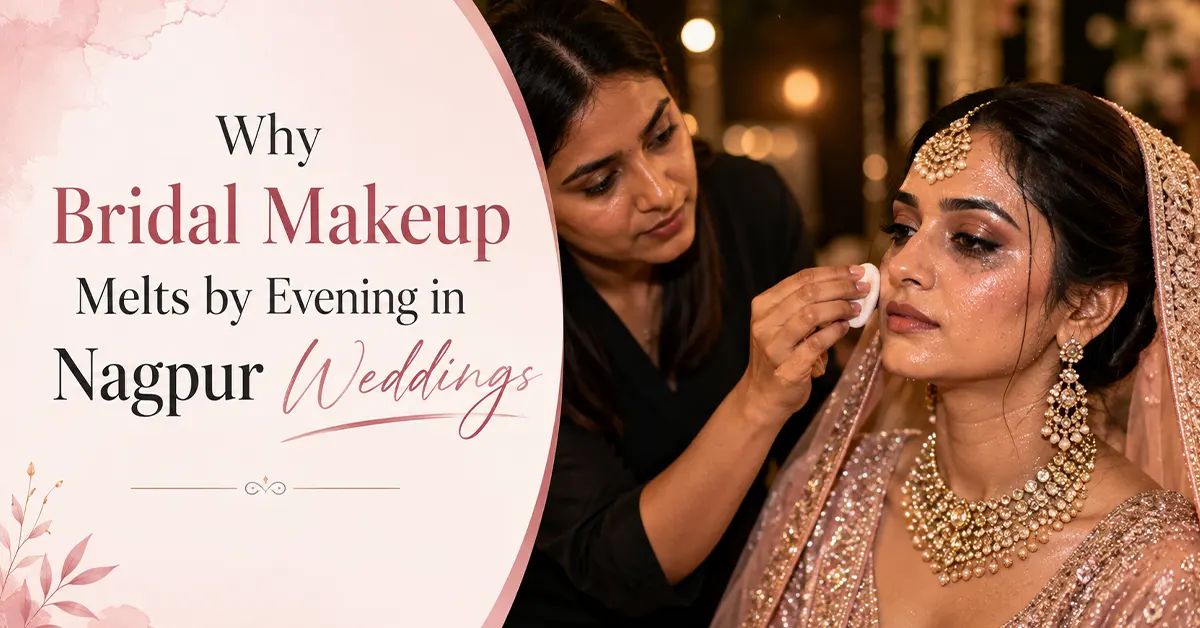
Why Bridal Makeup Melts by Evening in Nagpur Weddings
Bridal makeup typically fails by evening because of three compounding factors specific to Nagpur weddings: high daytime humidity and heat, back-to-back functions without touch-up breaks, and skin preparation that skips oil-control layering. Makeup applied with a heat-and-humidity-specific routine, including a mattifying primer, thin cream-to-powder layering, and strategic setting spray application, can realistically hold through a 10 to 14-hour wedding day without needing a full redo.
The Problem Every Nagpur Bride Recognizes
Ask any bride who got married between March and June in Nagpur, and she will describe the same moment: makeup that looked flawless in the morning photos starting to shift by the varmala ceremony, and looking noticeably different by the reception. This is not a failure of the bride’s skin or the makeup brand. It is almost always a mismatch between the makeup technique used and the climate the makeup has to survive.
Nagpur’s summer heat regularly crosses 40°C, and even winter weddings involve hours under stage lighting, crowded mandaps, and continuous movement between rituals. A technique that works beautifully for a two-hour photoshoot in an air-conditioned studio behaves completely differently across a full wedding day with haldi residue, sweat, tears, and repeated hugging of relatives. This is the exact gap Aditi Beauty School addresses in its bridal makeup training in Nagpur, teaching students to build looks for the real duration and climate of a wedding, not just a single flawless portfolio shot.
What Actually Breaks Down First
Base makeup breaks down at the T-zone first. Oil production increases with heat and stress, and the forehead, nose, and chin start showing shine or patchiness within two to three hours if the base wasn’t built to control oil from the start.
Powder-only setting fails under humidity. Loose powder alone absorbs oil temporarily but doesn’t create a barrier against humidity. In Nagpur’s climate, this means makeup can look matte for photos but start “sliding” the moment the bride steps outdoors or under heat-generating stage lights.
Traditional adornments accelerate wear. Sindoor application, garlands brushing against the face, and frequent touching during rituals like kanyadaan physically disturb the makeup in ways a standard bridal look isn’t always prepared for.
Emotional moments cause real makeup stress. Brides cry during rituals like bidaai. A technique that hasn’t accounted for tear-resistant, waterproof product choices around the eyes will visibly fail at exactly the moment being photographed most.
The Layering Approach That Holds Through a Full Wedding Day
- Oil-control skin preparation, not just moisturizing. Before any base product goes on, the skin needs a mattifying primer specifically in the T-zone, even on dry-skinned brides, because heat overrides normal skin type behavior for several hours.
- Thin layers instead of one heavy layer. A common mistake is applying a thick single layer of foundation for maximum coverage. Thin layers of cream-to-powder products, built up gradually and set individually, flex with the skin instead of cracking or sliding as a single mass.
- Baking only in movement-heavy zones. Baking with translucent powder under the eyes, around the nose, and along the jawline, held for a few minutes before dusting off, creates a stronger hold specifically where rituals cause the most friction and movement.
- Waterproof formulations for eyes and lips, non-negotiable. Given the near-certainty of tears, sweat, and eating during a Nagpur wedding, waterproof mascara, kohl, and long-wear lip color are not optional extras. They are the difference between makeup that photographs consistently across a 12-hour timeline and makeup that visibly changes between the morning and evening albums.
- Setting spray applied in stages, not once. A single setting spray application at the end of the routine is not enough for long-duration wear. Artists trained for Indian wedding timelines apply a light setting mist after the base, again after powder, and carry a travel-size spray for a mid-event refresh.
- A planned mid-event touch-up, not an emergency one. The most overlooked part of long-wear bridal makeup is a scheduled five-minute touch-up between the ceremony and reception, focused only on blotting oil and reapplying lip color, rather than waiting until makeup has visibly broken down to react.
Why This Is a Training Gap, Not Just a Product Gap
Many aspiring makeup artists learn techniques designed for studio or bridal-trial conditions, where lighting is controlled and the sitting is under two hours. Real wedding-day performance under Nagpur’s heat and event length is a different skill entirely, and it is one of the clearest gaps between artists who can do a beautiful trial look and artists who can be trusted with the actual wedding day.
This is exactly why climate-specific, duration-specific training matters for anyone serious about bridal makeup as a career. Understanding how a base behaves at hour eight of wearing, not just how it photographs at hour one, is what separates a portfolio-ready look from a wedding-ready one.
At Aditi Beauty School in Nagpur, bridal and HD makeup courses are built around these real event conditions rather than studio-only scenarios. Students train on full-duration bridal case studies, learn brand-tested product layering for local heat and humidity, and practice scheduled touch-up routines, so they graduate ready for real wedding bookings, not just trial looks. This hands-on, climate-aware approach is part of what makes Aditi Beauty School’s bridal makeup program distinct among professional makeup courses in Nagpur.
Key Takeaway
Bridal makeup breakdown in Nagpur weddings is predictable and preventable once the routine is built for heat, humidity, and event length rather than for a single perfect photo moment. Brides evaluating a makeup artist should ask specifically how the artist plans for touch-ups and long-wear performance, not just what brands they use. For aspiring artists, mastering this distinction is often what determines whether they get repeat bridal bookings or one-time trials, and it is precisely what Aditi Beauty School’s bridal and HD makeup courses in Nagpur are designed to teach.
faq's
1. Why does bridal makeup look different in morning versus evening wedding photos?
Heat, humidity, oil production, and physical contact from rituals gradually break down base makeup over several hours, changing its texture and coverage even if no one visibly "redoes" it in between.
2. Is waterproof makeup necessary for Nagpur weddings specifically?
Yes, given Nagpur's heat for most of the year and the emotional, ritual-heavy nature of Indian weddings, waterproof eye and lip products significantly reduce visible breakdown compared to standard formulations.
3. How many touch-ups does bridal makeup usually need in a full wedding?
Most 10 to 14-hour wedding days benefit from at least one planned mid-event touch-up focused on oil control and lip color, in addition to minor blotting as needed between rituals.
4. Can heavy, full-coverage foundation survive a full Indian wedding day better than lighter products?
Not necessarily. Thin, buildable layers set individually generally hold up better over long durations than one thick layer, which is more prone to cracking or shifting as a single mass.
