HD vs Airbrush vs Traditional Makeup: Which One Do You Actually Need?
Ask five different makeup artists to explain the difference between HD, airbrush, and traditional makeup, and you will likely get five slightly different answers, some contradicting each other entirely. That confusion is understandable. These terms get used loosely in salon marketing, and most clients booking a bridal or event look simply nod along without really knowing what they are paying for. At Aditi Beauty School, this is one of the most common questions students and clients both ask, so it is worth breaking down clearly, once and for all.
What "Traditional Makeup" Actually Means
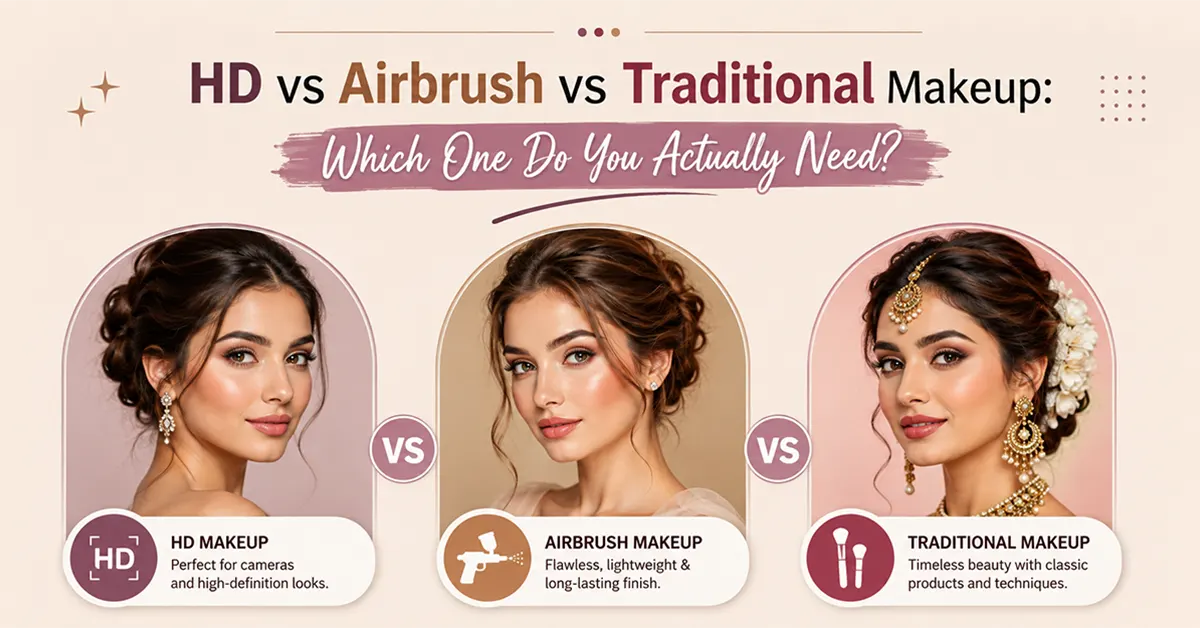
Traditional makeup refers to the standard application method most people are familiar with: cream and powder-based products applied with brushes, sponges, or fingers, built up in layers to create coverage and definition. It has been the industry standard for decades, and for good reason. It is versatile, works well across a wide range of skin types, and gives an artist full control over texture and buildable coverage during application.
The tradeoff is that traditional makeup, while excellent in person and under normal event lighting, can sometimes look heavier or less seamless under high-resolution photography and video, particularly with modern smartphone cameras and professional lenses that pick up texture and product buildup far more precisely than the human eye does.
What Makes Makeup "HD"
HD, or high-definition, makeup is not really a different application technique so much as a different formulation designed specifically to perform under high-resolution cameras. HD products are engineered with finer pigment particles and a more blendable texture that reduces the appearance of visible product on camera, avoiding the flashback, cakiness, or uneven texture that traditional makeup can sometimes show under close-up, high-resolution shots.
This matters enormously today, given how much of a modern Indian wedding is documented through candid photography, cinematic videography, and drone shots, often reviewed later frame by frame during editing. An artist trained specifically in HD techniques understands how to layer product, set it correctly, and match tones so the finished look holds up not just to the naked eye at the event, but to a 4K camera lens reviewing every frame months later.
What Airbrush Makeup Actually Does Differently
Airbrush makeup uses a different application method entirely. Instead of brushes or sponges, foundation and other products are applied using a small airbrush gun that mists a fine, even layer of product directly onto the skin. This creates an extremely lightweight, second-skin finish with excellent longevity, which is why it has become particularly popular for long wedding days involving multiple outfit changes, extended photography sessions, and hours of dancing in warm, humid conditions.
Airbrush makeup also tends to be highly water and sweat-resistant once set, making it a strong choice for outdoor ceremonies, destination weddings, or any event where an artist cannot easily do touch-ups throughout the day. The tradeoff is that airbrush application is a genuinely different skill from traditional brush-and-sponge work, requiring specific hands-on training on the equipment itself, correct product-to-air pressure ratios, and layering technique, which is exactly why a proper airbrush module within a course matters so much rather than a passing demonstration.
So Which One Should You Actually Choose?
The honest answer is that it depends entirely on the event, the venue, and what the finished look needs to survive. For an indoor event with controlled lighting and minimal camera pressure, traditional makeup, done well by a skilled artist, can look completely stunning and is often more cost-effective. For any event with heavy professional photography or videography, HD techniques give a meaningfully more polished result on camera. For long outdoor events, destination weddings, or situations where longevity and sweat resistance matter most, airbrush application tends to be the strongest choice.
Many experienced makeup artists, including those trained at Aditi Beauty School, do not treat these as three completely separate categories to choose between, but as complementary techniques that can be combined within a single look, using HD-formulated products with airbrush application for a finish that is both camera-ready and long-lasting, for instance. Understanding how these techniques interact, rather than treating them as isolated options, is part of what separates a genuinely skilled makeup artist from one working off a single fixed method.
Why This Matters If You Are Training to Become an Artist
For anyone considering a career in makeup artistry, this distinction is not just useful client-facing knowledge, it is a core professional skill. Clients today are increasingly specific in what they ask for, often requesting HD or airbrush makeup by name without fully understanding what they mean, which puts the responsibility on the artist to guide them toward the right choice for their actual event. A makeup artist who genuinely understands the technical differences between these methods, rather than simply offering whichever technique they learned first, builds far more trust with clients and commands stronger bookings as a result.
This is exactly why Aditi Beauty School structures its training to include genuine hands-on practice across traditional, HD, and airbrush techniques rather than treating any one of them as the default. Students leave with the ability to assess a client’s event, venue, and needs, and recommend the right approach with real technical understanding behind it, not just a sales pitch.
The Bottom Line
None of these three techniques is objectively “better” in isolation. Each one solves for a different priority: control and versatility with traditional makeup, camera performance with HD, and longevity and lightweight coverage with airbrush. The real skill, whether you are a client choosing for your own event or a student building a career, lies in understanding which priority matters most for the specific occasion in front of you.
Frequently Asked Questions
1. What is the main difference between HD and traditional makeup?
HD makeup uses finer, more blendable formulations designed to look seamless under high-resolution cameras, while traditional makeup uses standard cream and powder products applied by brush or sponge.
2. Is airbrush makeup better than HD makeup?
Neither is universally better. Airbrush offers lightweight, long-lasting, sweat-resistant coverage ideal for long events, while HD focuses specifically on how makeup performs under high-resolution photography.
3. Can HD and airbrush techniques be combined?
Yes, many skilled makeup artists combine HD-formulated products with airbrush application to achieve a finish that is both camera-ready and long-lasting.
4. Which makeup type is best for outdoor weddings?
Airbrush makeup is generally the strongest choice for outdoor or destination weddings due to its water and sweat resistance and long-wearing finish.
5. Does Aditi Beauty School teach both HD and airbrush techniques?
Yes, Aditi Beauty School provides hands-on training across traditional, HD, and airbrush makeup techniques as part of its course curriculum.
